The challenge of “delayed justice” requires a change in the mindset of the law enforcement system and courts, as well as in their approach to organizing work: Prosecutor General
12/01/2026
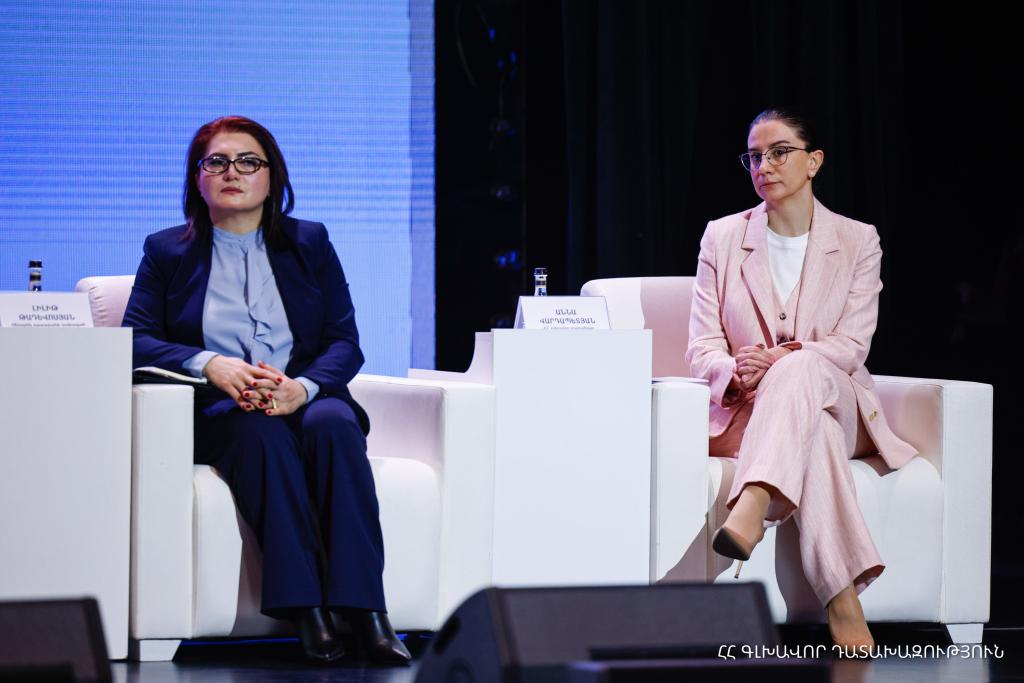
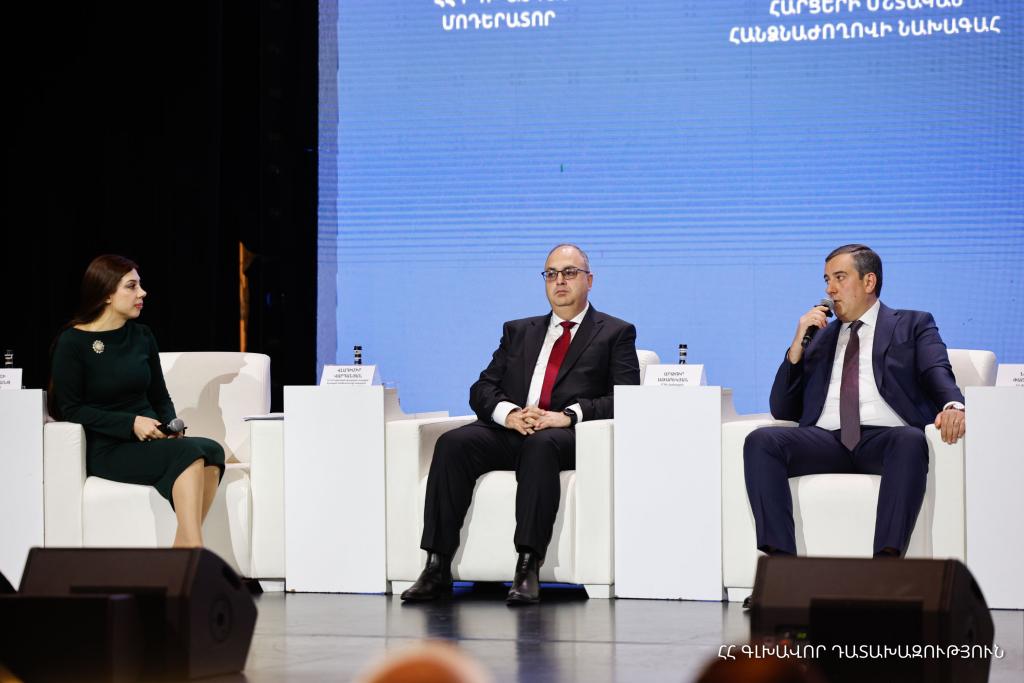
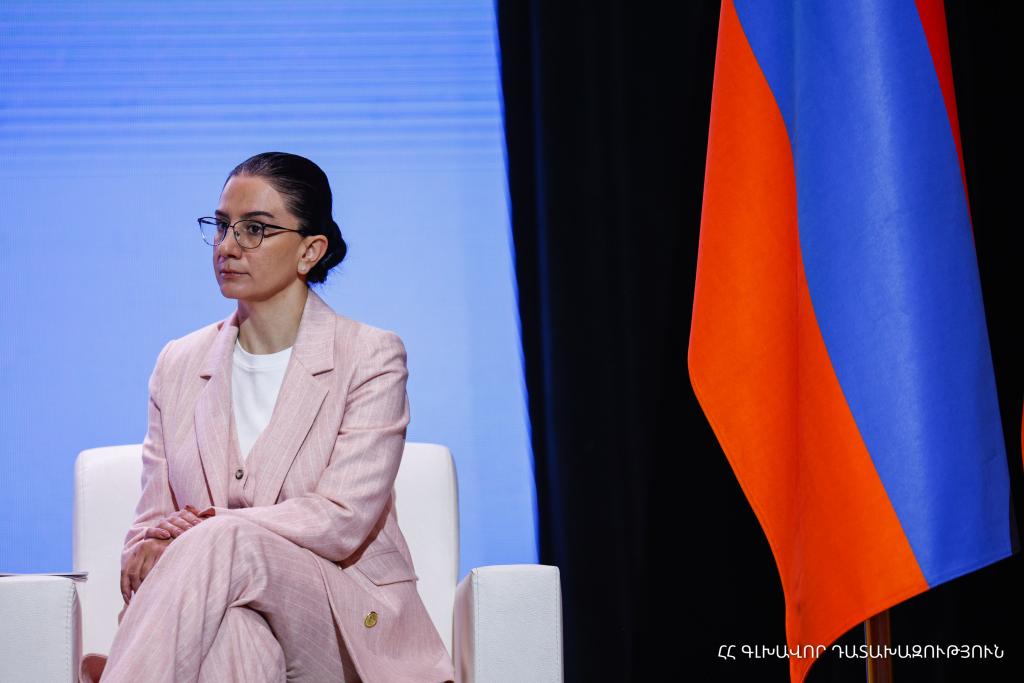
Anna Vardapetyan, the Prosecutor General of the Republic of Armenia, today participated in a panel discussion organized as part of an event dedicated to the Judicial Branch, together with Prime Minister Nikol Pashinyan, Chairman of the Supreme Judicial Council Artur Atabekyan, Minister of Justice of Armenia Srbukhi Galyan, Chairman of the Standing Committee on State-Legal Affairs of the National Assembly Vladimir Vardanyan, and President of the Court of Cassation Lilit Tadevosyan.
The event was opened with a welcoming address by the President of the Republic of Armenia, Vahagn Khachaturyan.
Prosecutor General Anna Vardapetyan, addressing a question from Eranuhi Tumanyan, a member of the Supreme Judicial Council and the panel moderator, regarding whether the increasing number of criminal cases in courts each year affects the quality of pre-trial and judicial proceedings, and whether there are additional solutions beyond those already identified to ensure cases are examined within a reasonable timeframe, stated: “I am grateful for the invitation to participate in the panel discussion organized as part of the event dedicated to the Judicial Branch. Ms. Tumanyan, I will break down your question into three layers and briefly but substantively address the challenges and solutions we have identified within each layer.”
“1. Increase in the number of criminal cases in courts.
In our view, one of the reasons for the absolute increase in the number of criminal proceedings submitted to courts with an indictment is the Prosecutor General’s Order of July 21, 2025, which established the criteria and procedures for evaluating the work of the prosecutor’s offices of the administrative districts of Yerevan and the regions.
The evaluation of prosecutors, in addition to final judicial acts in cases protecting state interests, the use of prosecutorial influence measures, or criminal proceedings, and the extent of damage recovered for the state or community, is also based on the number of criminal proceedings submitted to courts with an indictment for serious and particularly serious crimes, as well as the number of indictments in these cases that have entered into legal force.
The results of the evaluation of the work of the prosecutor’s offices of Yerevan’s administrative districts and the regions for the first half of 2025 show that these offices submitted 5,478 criminal proceedings to courts with approved indictments, of which 476 involved grave and particularly grave crimes, accounting for approximately 8.7% of the total.
This simple calculation demonstrates that if the effectiveness of the law enforcement and judicial system is assessed purely by absolute numbers (for example, the number of proceedings), the statistical picture may be misleading if it is not correlated with the severity of cases completed at the pre-trial and trial stages, and with the number of convictions in grave and particularly grave cases. From here, I will move to the second layer of your question:
- Does the number of criminal cases affect the quality of pre-trial and judicial proceedings?
The word “workload’ is the most frequently mentioned in discussions regarding law enforcement and judicial bodies: “we are overloaded with this many cases”—again, absolute numbers. If we continue the practice of assessments based solely on absolute numbers, one day we will mechanically conclude that heavy workload leads to poor quality. I sense that concern underlying your question. Of course, work quality will suffer if the same amount of time and energy is spent on both simple and complex legal issues, whether at the pre-trial stage or in court.
Let us make a brief mental exercise based on absolute numbers.
In the first half of 2025, convictions were issued in 4,706 cases involving 4,961 individuals. Of these, convictions in cases involving grave and particularly grave crimes were issued in 401 cases involving 523 individuals. In other words, grave and particularly grave crimes accounted for 8.5% of all convictions.
For comparison, in the first half of 2024, convictions were issued in 3,819 cases involving 4,024 individuals. Of these, convictions for grave and particularly grave crimes were issued in 436 cases involving 521 individuals. Thus, the share of grave and particularly grave crimes among all convicted cases was 11.4%.
This means that in the first half of 2025, the number of cases concluded with a conviction increased by 887 cases, or 23.2%, compared to the same period in 2024. Meanwhile, the number of convictions for grave and particularly grave crimes decreased by 35 cases, or 8%.
From this analysis, my conclusion is that there is a need for reform in the organization of work and in tactical and strategic planning aligned with work objectives. This is not about legislative reforms; it is about changing the mindset and approach to work and moving away from evaluating our workload solely based on absolute numbers.
The third layer of your question is directly connected to this change.
- Beyond the solutions already identified, are there other ways to ensure cases to be examined within a reasonable timeframe?
“Yes, there are, and the empirical basis for my answer is the case processing chronology of the Court of Gegharkunik region over a nine-month period in 2024. During this period, 472 criminal cases were concluded, and the number of pending criminal cases was 136. In simpler terms, more cases were completed than were submitted to the Court of General Jurisdiction of Gegharkunik, resulting in a decrease in pending cases. Several factors contributed to this dynamic:
- The frequency of scheduling court sessions,
- Eliminating absences of prosecutors from sessions,
- Active measures to ensure the presence of parties,
- Agreeing on the session date with parties in advance, and applying sanctions for disrespectful absences by defense attorneys,
- Holding court sessions for extended periods—nearly the full working day (sessions lasting only one hour and postponed due to another court session were ineffective).
Analysis of this example shows that scheduling two to three substantive (non-formal) sessions per month reduces the likelihood of trial delays.
The conclusion of court cases was also facilitated by the use of procedures allowing consensual fines and expedited trials, which made it possible to schedule other court sessions more frequently.
This reality provides evidence on the ground of effective tactical and strategic planning in work organization that aligns with objectives. Lack of such planning results in cases not being concluded within reasonable timeframes, which legal professionals refer to as “delayed justice.”
Again, let us do a brief exercise based on absolute numbers:
- In 2020, criminal prosecution was terminated for 61 individuals due to statute of limitations expiry in cases at the trial stage,
- In 2021 — 233 individuals
- In 2022 — 343 individuals
- In 2023 — 519 individuals
- In 2024 — 533 individuals
- In the first half of 2025 — 118 individuals.
The trend is evident, however, there are objective grounds to halt it in the foreseeable future. One of these is that the new Criminal Code, effective from July 1, 2022, provides for longer statutes of limitation.
According to part 1 of Article 83 of the Criminal Code:
“1. A person shall be released from criminal liability, where the following terms have elapsed from the day following the completion of the criminal offence:
1) 5 years (2 pursuant to former Criminal Code) in case of a criminal offence of minor gravity;
2) 10 years (5 pursuant to former Criminal Code) in case of a criminal offence of medium gravity;
3) 15 years (10 pursuant to former Criminal Code) in case of a grave criminal offence;
4) 20 years (15 pursuant to former Criminal Code) in case of a particularly grave criminal offence.”
Moreover, the method of calculating the statute of limitations has changed. Under part 2 of Article 83 of the new Criminal Code, unlike the previous code, the limitation period is calculated from the day following the commission of the crime until the decision to initiate criminal prosecution against the individual is made. Previously, it was calculated from the day the crime was considered completed until the verdict entered into legal force.
This is an important change because often, before a court judgment comes into legal force, the statute of limitations expires, and the time and material resources spent by both the law enforcement system and the court become wasted.
Of course, these provisions apply to offenses committed after the entry into force of the new Criminal Code. For crimes committed previously, the challenge of ensuring cases are concluded within a reasonable timeframe remains relevant today.”