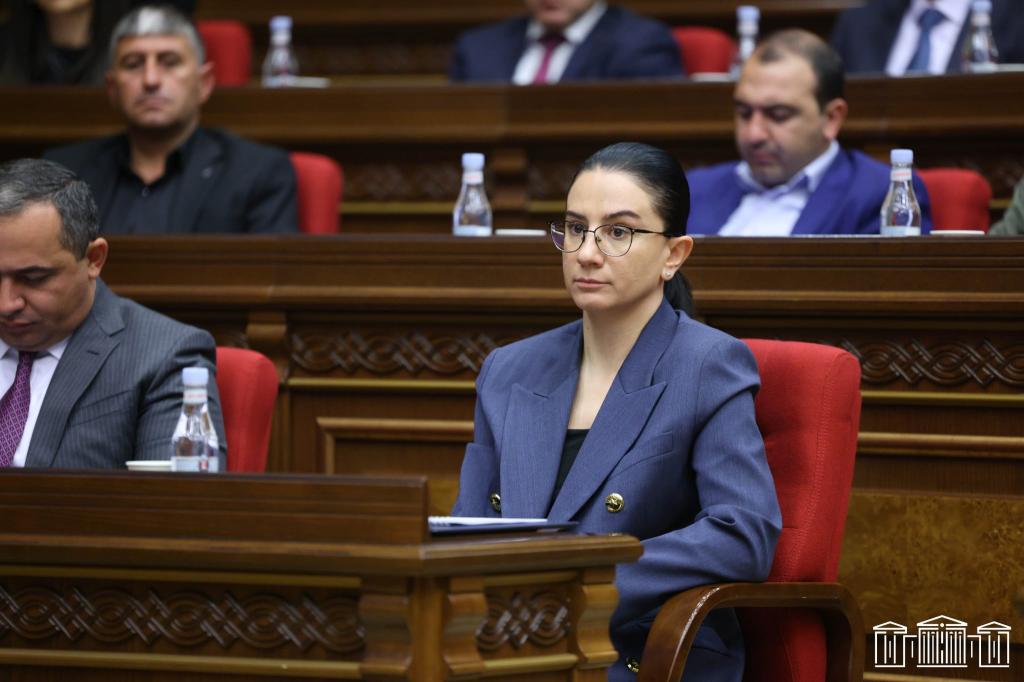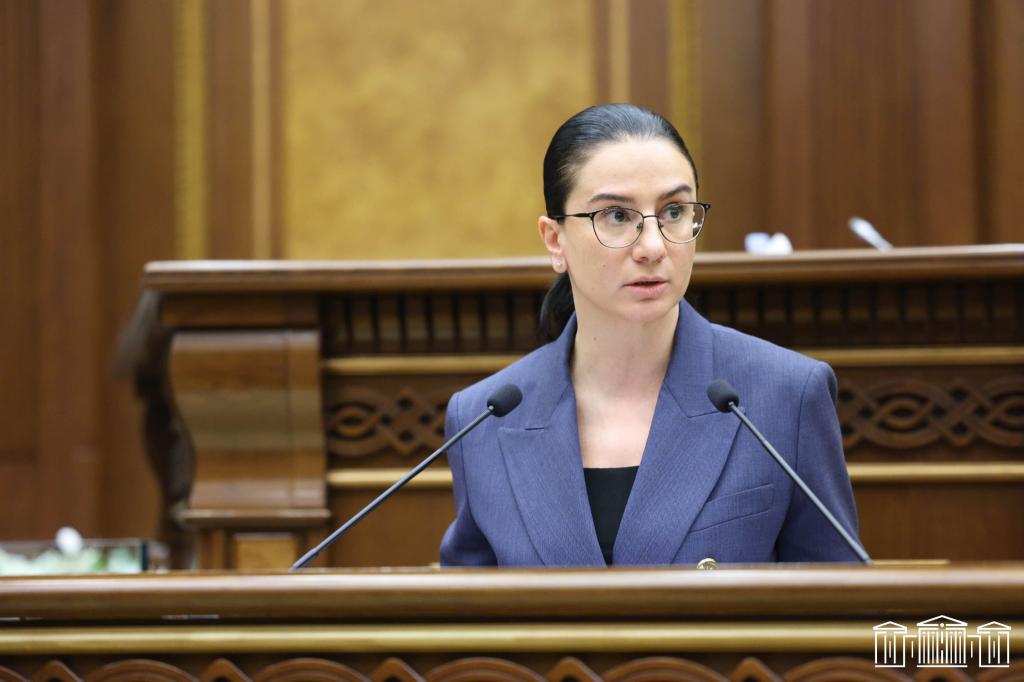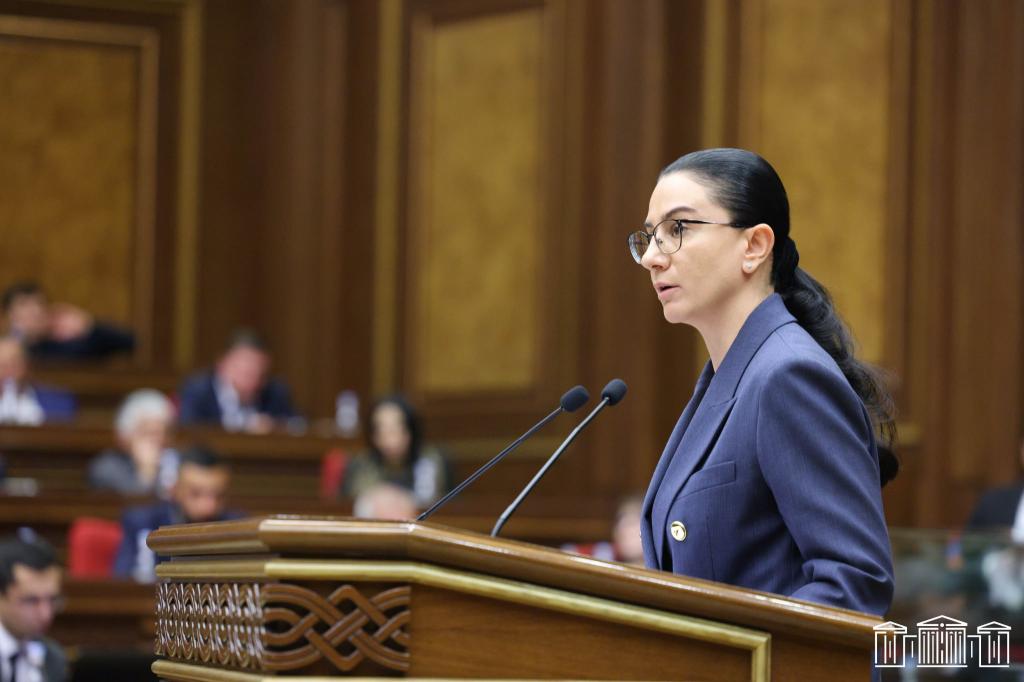
In the National Assembly, the Prosecutor General referred to the actions taken by the Prosecutor's Office under the “March 1” case from 2022 to the present within the framework of the prosecution and state interests protection
18/11/2025
Today, Anna Vardapetyan, Prosecutor General of the Republic of Armenia, took part in a public discussion held in the National Assembly on the topic: the investigation of the “March 1” case in the preceding period and the reinterpretation of the “March 1” case in light of the judgment in the case of “Farmanyan and Others v. Armenia”.
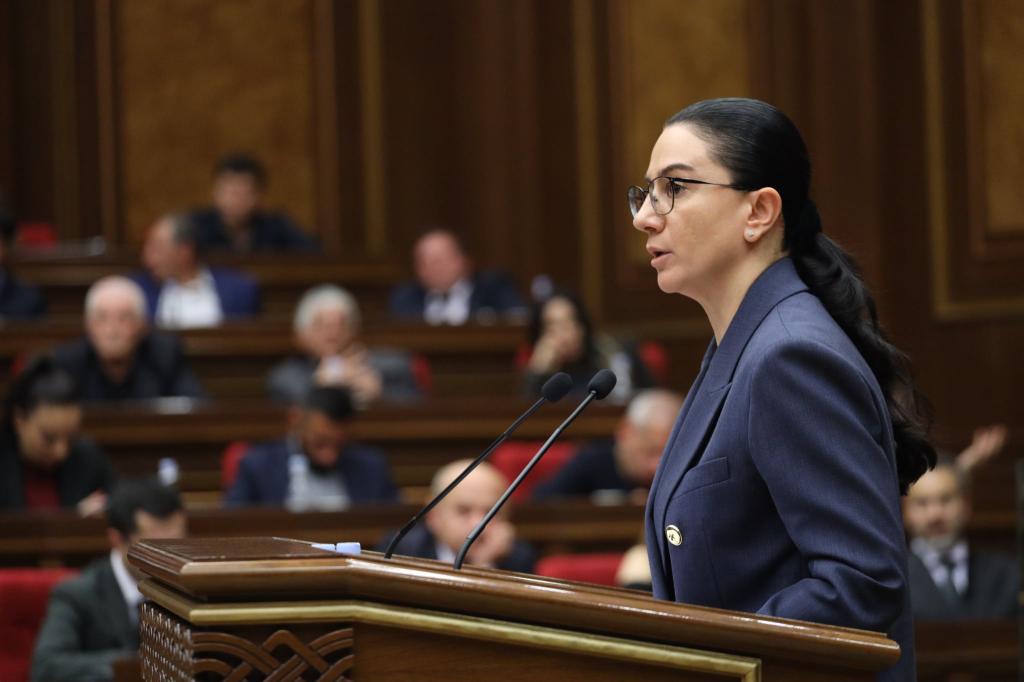
During the public discussion, the Prosecutor General of the Republic of Armenia delivered a speech on the topic “Defense of the Prosecution in Court in the “March 1” Case, particularly noting the following:
- Let me remind you that by the Constitutional Court’s decision of March 26, 2021, Article 300.1 of the Criminal Code (overthrowing the constitutional order) was declared invalid as it contradicted Articles 78 and 79 of the Constitution. Based on the Constitutional Court’s decision, on April 6, 2021, the Court of First Instance terminated the criminal prosecution under part 1 of Article 300.1 of the former Criminal Code against the defendants Robert Kocharyan, Seyran Ohanyan and Yuri Khachaturov, as well as under Article 38–300.1 of the Criminal Code against Armen Gevorgyan, on the grounds of absence of a crime, and the criminal proceedings were suspended in that part.
All appellate complaints filed against the above-mentioned decision were rejected, and the April 6, 2021 decision of the Court of First Instance was left unchanged.
The Prosecutor General of the Republic of Armenia filed a cassation appeal against the decision of the appellate court, requesting to overturn of the lower court decisions and to submit the criminal case for a new trial.
By its decision of March 18, 2022, the Court of Cassation accepted the cassation appeal filed by the Prosecutor General of the Republic of Armenia for consideration.
According to its decision of January 19, 2024, the Court of Cassation referred several articles of the former Criminal Procedure Code to the Constitutional Court to determine their compliance with the Constitution.
By its decision of July 22, 2024, the Constitutional Court recognized part 3 of Article 309.1 of the former Criminal Procedure Code as constitutional, interpreting it to mean that the prosecutor may amend the charge (i.e., the legal characterization of the act attributed to the accused) before the court retires to the deliberation room, if the act committed by the accused contains elements of another offense provided by criminal law, regardless of the examination of evidence during the trial.
Based on the decision of the Supreme Judicial Council, the powers of the judge handling the case were terminated, and on September 2, 2024, the criminal case was assigned to another judge of the Court of First Instance of General Jurisdiction of the Yerevan city.
On September 12, 2024, the Court of Cassation overturned the April 16, 2021 decision of the Court of First Instance of General Jurisdiction of the Yerevan city and the November 26, 2021 decision of the Criminal Court of Appeals on leaving the decision abovementioned unchanged and submitting the case to the Anti-Corruption Court for a new trial.
Inter alia, the Court of Cassation noted that, in light of the Constitutional Court’s decision of July 22, 2024, if the prosecutor considers that the committed act may be qualified under another article of the Criminal Code, they are authorized to take steps aimed at supplementing or amending the charge.
On October 11, 2024, the public prosecutor issued decisions to amend the legal assessment of the act previously attributed to Robert Kocharyan, Seyran Ohanyan, Yuri Khachaturov and Armen Gevorgyan under part 1 of Article 300.1 of the Criminal Code adopted on April 18, 2003, and to bring new charges against them under part 3 of Article 309 of the same Code (corresponding to point 5 of part 2 of Article 441 of the current Criminal Code).
On November 24, 2025, the court granted the public prosecutor time for drafting and submitting the aforementioned decisions in compliance with the requirements of the Criminal Procedure Code. The amended charges will be submitted to the court in the near future.
- On August 11, 2025, the Prosecutor General’s Office submitted a claim to the Anti-Corruption Court against Robert Kocharyan, Armen Gevorgyan, Seyran Ohanyan, and Yuri Khachaturov, demanding the joint recovery, by way of recourse, of 670 million drams compensated by the Republic of Armenia.
The amount of the recourse claim was calculated on the basis of:
The Law of the Republic of Armenia “On Support to Persons Affected During the Events of March 1–2, 2008 in Yerevan”, adopted by the National Assembly on June 4, 2009, on the basis whereof Government Decision No. 990-N of August 8, 2019 was adopted;
The letter of the Secretary General of the Ministry of Justice dated October 25, 2024, according to which the amount of support provided to persons affected during the events of March 1–2, 2008 in Yerevan up to October 25, 2024 amounts to AMD 670 million.
At the same time, the Prosecutor General’s Office submitted a motion to apply a measure securing the claim, requesting that an attachment in the amount of the claim — AMD 670 million— be imposed on the property belonging to the defendants Robert Kocharyan, Armen Gevorgyan, Seyran Ohanyan and Yuri Khachaturov.
By its decision of August 13, 2025, the Anti-Corruption Court accepted the claim for examination and granted the motion on applying the measure securing the claim.
- On the same day, August 11, 2025, by decision of the Prosecutor General, the decision of January 30, 2020 to terminate the criminal prosecution against Sasha Afyan, who held the position of Deputy Chief of Police as of March 1, 2008, was revoked.
Under the “March 1” case, it was established that Sasha Afyan, who had been appointed Deputy Chief of Police under the Government on February 12, 2008, exceeded his official authority on March 1, 2008 and, acting in complicity with others, organized the actions carried out by various police units to disperse the peaceful demonstrators holding a sit-in in Yerevan’s Freedom Square through the use of violence and special means, and subsequently to prevent their gatherings and any possible demonstrations in the central areas of the city. These actions caused substantial harm to the rights and lawful interests of individuals, as well as to the lawful interests of society and the state.
According the decision of the Prosecutor General, it was recorded that: “(…) On the evening of February 29, 2008, Chief of Police Hayk Harutyunyan convened a meeting during which he ordered the heads of the subdivisions to disperse the peaceful demonstrators gathered in Yerevan’s Freedom Square and to prohibit the holding of assemblies in the mentioned square.
Following this meeting, during the night of February 29 to March 1, Deputy Chief of Police Sasha Afyan urgently gathered the officers of the Patrol Service Regiment of the Yerevan City Department of the Police, after which he instructed the regiment’s command to equip the personnel with special means and to transfer them to the aforementioned square in order to disperse the peaceful demonstrators holding a sit-in in Freedom Square.
At around 06:30, approximately 1,200 police officers, including officers of the Patrol Service Regiment of the Yerevan City Department of the Police, were deployed in the streets adjacent to Freedom Square. Thereafter, the officers of the Patrol Service Regiment, under the organization of Sasha Afyan and in the absence of grounds for the use of physical force or special means as prescribed by Article 29 of the Law of the Republic of Armenia “On Police”, entered the square, clearly exceeding their authority. Their actions, accompanied by unlawful use of violence (physical force) and special means, resulted in the dispersal of hundreds of peaceful demonstrators holding a sit-in and their forcible removal from the square. At the same time, other police units, with the aim of preventing further gatherings and assemblies in the square, cordoned off Freedom Square and blocked citizens’ access to it. After the demonstrators were forcibly removed from Freedom Square, police forces, organized by Sasha Afyan and others, continued pursuing citizens throughout the central areas of the city, using violence and special means to prevent their gatherings and any possible demonstrations. As a result of the actions carried out by the police in Freedom Square and the adjacent streets, more than thirty citizens sustained minor and moderate bodily injuries, and these actions caused substantial harm to the rights and lawful interests of individuals, as well as to the lawful interests of society and the state.
On October 26, 2019, a decision was made to charge Sasha Afyan under part 2 of Article 38–309 of the Criminal Code, and the charges were brought on the same day.
Article 309 of the Criminal Code adopted on April 18, 2003, provided for criminal liability for an official who intentionally commits actions that clearly exceed the scope of their authority and cause substantial harm to the rights and lawful interests of individuals or organizations, or to the lawful interests of society or the state (in the case of property damage — an amount exceeding five hundred times the minimum salary established at the time of the offense, or its value).
Part 2 of the Article provides for a qualified composition of exceeding official authority, namely the same act committed with the use of violence, weapons or special means.
The decision of the Prosecutor General also recorded that: “The defendant Sasha Afyan in his testimony requested that the criminal prosecution initiated against him under part 2 of Article 38–309 of the Criminal Code adopted on April 18, 2003, be terminated on the grounds of expiration of the statute of limitations.
Considering that Sasha Afyan’s act of exceeding official authority accompanied by the use of violence, weapons, or special means was completed on March 1, 2008, and therefore the statute of limitations for holding him criminally liable—prescribed by point 3 of part 1 of Article 75 of the Criminal Code adopted on April 18, 2003—had expired, on January 30, 2020, Hrachya Musheghyan, the investigator conducting the proceedings, Deputy Head of the Department for the Investigation of Corruption, Organized and Official Crimes of the Special Investigative Service, issued a decision to terminate the criminal prosecution initiated against Sasha Afyan under part 2 of Article 38–309 of the Criminal Code adopted on April 18, 2003, in criminal case No. 62202608, on the grounds of expiration of the statute of limitations for criminal liability.
The supervising prosecutor responsible for overseeing the legality of the preliminary investigation in criminal case No. 62202608 did not revoke the above-mentioned decision, thereby confirming its legality.
According to the decision of the Prosecutor General, the decision of January 30, 2020 issued by the investigator conducting the proceedings—on terminating the public criminal prosecution initiated against Sasha Afyan under part 2 of Article 309 of the Criminal Code of the Republic of Armenia adopted on April 18, 2003—and the procedural act of the supervising prosecutor not revoking that decision, are unlawful and unsubstantiated and are subject to annulment.
The decision of the Prosecutor General is based, inter alia, on domestic legislation, international instruments and the judgment of the European Court of Human Rights in the case of Mushegh Saghatelyan v. Armenia, as well as on the decision of the Court of Cassation of December 23, 2023, according to which, at least as of August 1, 2003—the date of entry into force of the Criminal Code adopted on April 18, 2003—there existed a legislative prohibition on the application of statutes of limitations in cases involving torture or treatment equivalent to torture, including cases where an official exceeded authority accompanied by violence.
Therefore, the act attributed to Sasha Afyan constituted conduct which, as a form of ill-treatment, is equated with torture, and accordingly the public criminal prosecution initiated against him could not have been terminated due to the existence of a legislative prohibition on applying statutes of limitations.
This count will soon be submitted to the court with an indictment.